

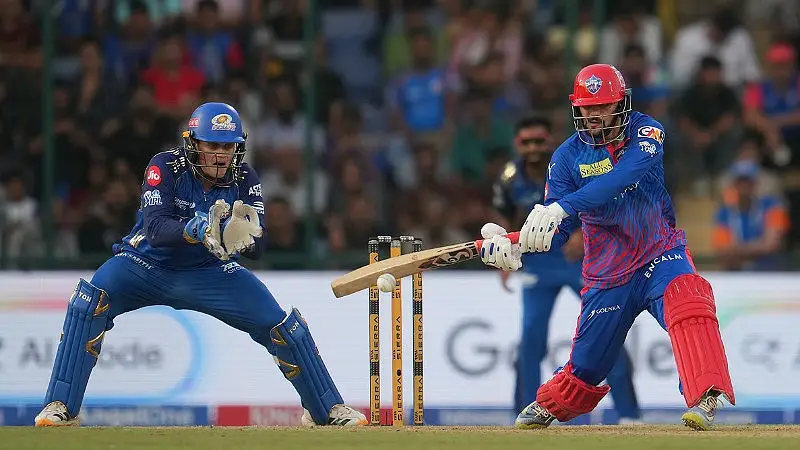

Axar Patel didn’t bowl Kuldeep Yadav when MI expected him. He didn’t use T. Natarajan in the power play when convention said he should. He didn’t lock any bowler into a fixed-over allocation regardless of how the match was moving. Delhi Capitals beat Mumbai Indians with a bowling plan that was built around one principle: take wickets rather than contain runs, and execute through a series of decisions that looked unconventional in the moment and obvious in hindsight. MI’s batting lineup is built to absorb containment bowling and punish defensive captaincy. DC gave them neither.
No Fixed Roles No Predictable Patterns
The specific tactical signature of DC’s win was the absence of bowling predictability. T. Natarajan didn’t follow the standard death-over specialist deployment that most IPL teams use as their default structure. Kuldeep came in later than opposition analysts anticipated. Bowlers who took wickets weren’t extended beyond the point where their spell remained effective. Every decision was made against the match situation rather than against a pre-match plan that the opposition had already modelled. MI’s batting lineup prepares for predictable bowling structures. DC gave them a bowling structure that changed based on what was happening rather than what was planned to happen.
Powerplay Aggression Broke MI’s Top Order
DC identified early that defensive powerplay bowling against MI’s top order produces expensive overs rather than wickets. Rohit Sharma’s recent form, 200-plus strike rate in the powerplay, means defensive lines become scoring opportunities. Attacking lines with movement creates genuine uncertainty. DC chose to attack. The result was early wickets that forced MI’s innings into rebuild mode before it had established the platform that makes their later-order acceleration threatening. When Rohit goes early, the partnership that makes MI’s total competitive disappears before the middle overs have begun. DC’s powerplay bowling plan targeted that specific match-defining moment.
IPL 2026 Kuldeep Introduction Changed Everything
Delaying Kuldeep Yadav’s introduction against MI is the tactical decision that most clearly separates DC’s approach from conventional IPL captaincy. The standard reading is: introduce your best spinner when the surface offers assistance, and the match-up favours the bowling type. DC waited for something more specific, the batting combination that most disfavoured Kuldeep, having been worn down by the pace options, creating a scenario where his introduction arrived with no tactical warning for the batters now facing him. The delayed introduction in IPL 2026 produced a higher impact per over than an earlier introduction against the same players would have. Timing rather than selection won that phase.
DC Chose Wickets Over Containment Deliberately
The philosophy behind DC’s bowling performance isn’t accidental; it’s a clear tactical choice about what wins T20 matches against batting lineups of MI’s quality. Containment bowling assumes the batting team eventually makes mistakes under run-rate pressure. Against MI’s depth and experience, that assumption is wrong. Rohit, Suryakumar, and De Kock all know how to manage a chase from behind. Containment doesn’t create the pressure that produces errors from batters who’ve done this hundreds of times. Wickets do. Removing the batter is the only method that definitively solves the match-up problem. DC’s aggressive intent, attacking fields, bowling for edges rather than dots, reflects an understanding of that specific principle.
MI’s pre-match preparation modelled DC’s bowling plan based on their previous performances. They identified the death-over bowler, the powerplay aggressor, and the spinner’s likely introduction. That preparation became partially irrelevant because DC’s actual bowling structure didn’t match the predicted one closely enough for MI’s batting plan to remain fully applicable.
- Does DC’s flexible bowling plan work against every opposition, or did MI’s specific batting structure make it uniquely vulnerable to this approach? Drop your take and follow for IPL updates.
FAQs
What is Delhi Capitals’ bowling tactics analysis in IPL?
It refers to how DC plans and executes bowling strategies based on match-ups, conditions, and game situations rather than fixed roles.
Why did Axar Patel delay key bowlers against the Mumbai Indians?
To optimize match-ups and avoid predictable patterns, ensure that bowlers face favorable batting conditions.
How does DC vs MI’s bowling strategy breakdown differ from other teams?
DC emphasized flexibility and wicket-taking, while many teams still rely on fixed bowling phases.
Which role does Kuldeep Yadav play in DC’s bowling strategy?
He is used strategically in the middle overs when conditions and match-ups favor spin impact.
Can aggressive bowling tactics work consistently in T20 cricket?
Yes, especially against strong batting teams, as wicket-taking disrupts momentum more effectively than defensive play.