

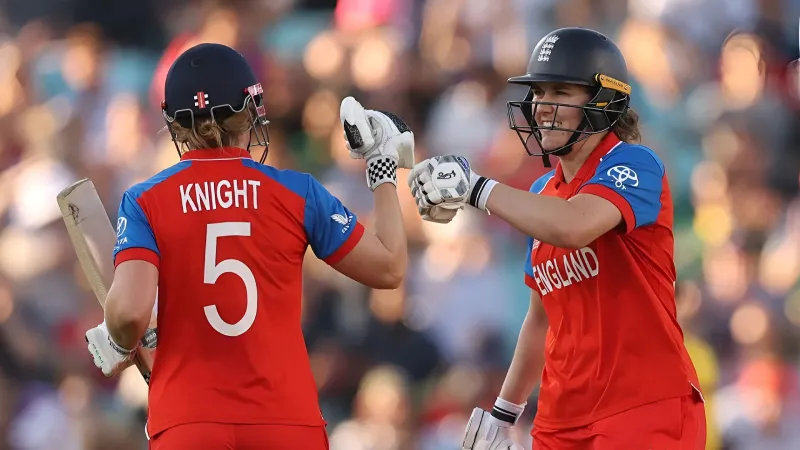

Twice this tournament, England’s top three have fallen inside the powerplay, and twice Nat Sciver-Brunt and Heather Knight have rebuilt the innings from there. Against Ireland it was 35/3 chased down calmly; against South Africa it was 23/3 turned into a match-winning total. That repetition is the real story heading into Sunday, more revealing than either individual score on its own. It suggests England have built a genuine mechanism for adversity, not just a habit of getting lucky on a good day, and that distinction matters against an unbeaten opponent.
A Pattern Not A Single Rescue Act
England’s 133-run stand from 23/3 against South Africa was not an isolated rescue act. It follows an almost identical script from the group stage, when a top-order collapse against Ireland left the innings needing repair before a modest run chase of just 119.
Match | Score At Fall Of 3rd Wicket | Final Score | Result |
vs Ireland (Group Stage) | 35/3 | 119/6 (17.3 ov) | Won by 4 wickets |
vs South Africa (Semi-Final) | 23/3 | 169/5 | Won by 40 runs |
Both times England were three wickets down inside the powerplay. Both times Sciver-Brunt and Knight came together to repair the innings. The semi-final version was more emphatic, a 133-run stand rather than 64, but the underlying script stayed the same: openers gone cheap, panic averted by the captain and her predecessor, and a target that looked shaky at the halfway mark turned comfortable by the close.
England Women’s T20 World Cup 2026 Final
England now carry that recovery habit straight into the biggest match of the tournament. A second rescue act inside three matches is no longer a coincidence; it is a demonstrated method: identify the collapse early, absorb the pressure, and let the middle order rebuild from a position that would sink most batting lineups on either side of this draw.
What makes it repeatable rather than lucky is the personnel involved. The same two players have solved the same problem twice, under different degrees of pressure, against different bowling attacks and different match situations. That consistency is what separates a genuine method from a string of fortunate afternoons that happened to fall the right way.
The Partnership Behind Both Recoveries
Sciver-Brunt missed three group games with a recurring calf injury, returning for the semi-final to make an immediate impact with 75 off 47 balls. She had also top-scored with 48 in the Ireland chase before retiring hurt as a precaution.
Knight’s contributions have mattered just as much when it counted, 58 off 47 in the semi-final and 26 in the Ireland rescue. England’s spin attack has carried its own weight too, with Sophie Ecclestone taking 37 wickets across 23 T20 World Cup innings at an economy under five. But it is the batting partnership between England’s past and present captains that has repeatedly turned pressure into platform, giving the rest of the dressing room evidence that a poor start does not have to mean a bad day.
The Test Awaiting Against Australia’s Attack
Australia arrive at Lord’s unbeaten and formidable, but England’s recurring recovery mechanism offers a specific kind of reassurance heading into Sunday. If the new-ball bowlers strike early, as attacks with real pace tend to do, England have now shown twice that an innings does not have to unravel from there.
This is not faith in experience as some abstract quality. It is a specific pairing that has already answered the same question twice, under different degrees of pressure. Whether that holds against a stronger, more clinical Australian attack is the actual examination Sunday poses.
Lord’s Wants Fuller Stands On Sunday
Away from the middle, MCC chief executive Robert Lawson wrote to members this week urging them to fill their seats at Lord’s regardless of who reached the final. He explicitly invoked the memory of the 2017 Women’s World Cup final, when the public stands were packed, but the pavilion sat conspicuously empty.
More than 160,000 tickets have already been sold across the tournament, a record for a women’s ICC event, and Lawson asked absent ticket-holders to release their seats so others could use them. It is a reminder that even as England chase a mechanism-driven route through the England Women’s T20 World Cup 2026 final, cricket’s oldest ground is still working out how to match the occasion.
Can Sciver-Brunt and Knight solve the same problem a third time against Australia’s attack? Share your prediction for Sunday’s final.
FAQs
When is the Women’s T20 World Cup 2026 final?
Sunday, July 5, 2026, at Lord’s. Australia are the confirmed opponents after England’s semi-final win over South Africa, with the match starting in the afternoon at cricket’s home ground.
Who has England lost to in previous Women’s T20 World Cup finals?
Australia, in 2012, 2014, and 2018. All three defeats came in major ICC finals, making Sunday’s rematch the fourth time the sides have met on the biggest stage.
How many runs did Nat Sciver-Brunt score in the semi-final?
She scored 75 off 47 balls. It was her first major innings after returning from a calf injury that ruled her out of three group games.
Where is the Women’s T20 World Cup 2026 final being played?
Lord’s Cricket Ground in London. More than 160,000 tickets have been sold across the tournament, a record for a women’s ICC event, and organisers are urging fans to fill every seat.
How many times have England reached a Women’s T20 World Cup final?
Five times, in 2009, 2012, 2014, 2018, and now 2026. They have won the title only once, back in 2009, and lost the other three finals to Australia.
Disclaimer: This blog post reflects the author’s personal insights and analysis. Readers are encouraged to consider the perspectives shared and draw their own conclusions.