

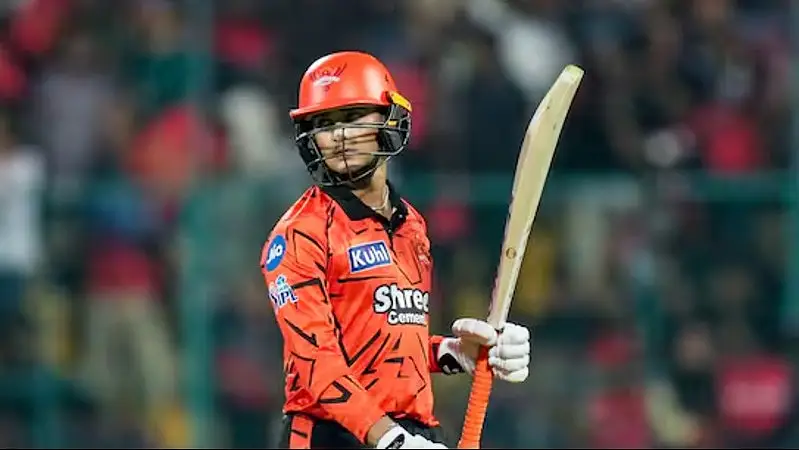

Abhishek Sharma has always been capable of hitting. What he showed against the Delhi Capitals was something different entirely: the ability to think. His 135 off 68 balls wasn’t the most explosive innings he’s played this season; his 141 off 55 against a weaker attack was technically faster, but it was almost certainly the most complete. He read conditions, adjusted his tempo when the Hyderabad surface slowed, and batted through all 20 overs to give SRH a total that was always going to be difficult to chase. This was a different version of Abhishek, and it might be the better one.
Control Replaced Chaos Against DC
The Hyderabad pitch against DC didn’t offer the easy pace and carry that turns aggressive hitting into inevitable boundaries. Abhishek recognised that early and made a decision most attacking top-order batters wouldn’t: he held back deliberately.
His power play was measured rather than brutal. He targeted deliveries in his hitting arc, avoided forcing shots against the conditions, and accepted singles when boundaries weren’t genuinely available. The innings never lost its shape because he never lost patience with the surface. Rather than fighting the conditions, he worked with them until they changed in his favour during the back ten overs.
That decision to prioritise longevity over immediate impact is exactly what SRH’s fragile middle order most needed from their opener.
What the Numbers Actually Reveal
His previous 141 off 55 balls came with a control percentage of around 66%. Against DC, that figure climbed to roughly 85%. He hit a similar number of sixes but fewer fours, which tells you precisely where the adjustment was made. He stopped chasing ground shots through gaps that weren’t quite there and focused instead on clean, high-reward hits over the boundary.
Facing 68 deliveries while scoring 135 requires a strike rate just under 199. That isn’t conservative by any standard. It’s calculated. The difference between this innings and his earlier ones isn’t the destination of big runs, a dominant performance, it’s the method used to get there.
Innings | Score | Balls | Strike Rate | Control % |
vs DC, IPL 2026 | 135* | 68 | 198.5 | ~85% |
Previous best | 141 | 55 | 256.4 | ~66% |
IPL 2026 Forced a Role Change
Running IPL has consistently exposed teams that rely on one-dimensional top-order contributions. SRH’s middle order hasn’t been reliable enough to compensate when the top falls cheaply, which places far greater responsibility on Abhishek than a pure powerplay aggressor would typically carry.
He recognised that responsibility against DC. Instead of a 30-ball cameo that left the innings exposed from the 10th over onward, he took ownership of the entire knock from first ball to last. Heinrich Klaasen’s slightly reduced strike rate this season reflects the same awareness within the same dressing room. When the top order commits to batting deep, the middle order can accelerate from a position of strength rather than attempt to rescue a collapsing innings.
Where This Evolution Takes Abhishek
A batter who can both anchor and accelerate is genuinely rare in T20 cricket. Most players are comfortably one or the other. Abhishek is showing real signs of being both, which makes him considerably more valuable to SRH than a pure powerplay aggressor who contributes 30 balls and then departs.
The comparison to how Kohli and Rohit evolved their T20 games from instinct-led power to structured, conditions-aware batting isn’t a stretch. Abhishek is 24. If this innings represents a genuine shift in mindset rather than a situational one-off, SRH have something special anchoring their batting order for several seasons to come.
- Is Abhishek Sharma the most complete T20 opener in the tournament right now, or can Gill and Klaasen still challenge him for that title? Drop your pick in the comments and follow for IPL updates.
Q: What made Abhishek’s 135 off 68 different from his 141 off 55?
The control percentage jumped from 66% to 85%, reflecting a shift from explosive hitting to calculated shot selection across all 20 overs.
Q: Why did he bat more conservatively against the Delhi Capitals?
The Hyderabad pitch was slower than usual, making timing harder. He adapted his tempo rather than forcing shots against the conditions.
Q: How does this approach benefit SRH as a team?
With Abhishek batting deep, SRH’s middle order accelerates from a strong platform instead of rescuing a collapsing innings under pressure.
Q: Does this evolution strengthen Abhishek’s case for India’s T20 setup?
Yes. A batter who can both anchor and accelerate across 20 overs is exactly the profile India’s selectors look for at the top of a T20 batting order.