

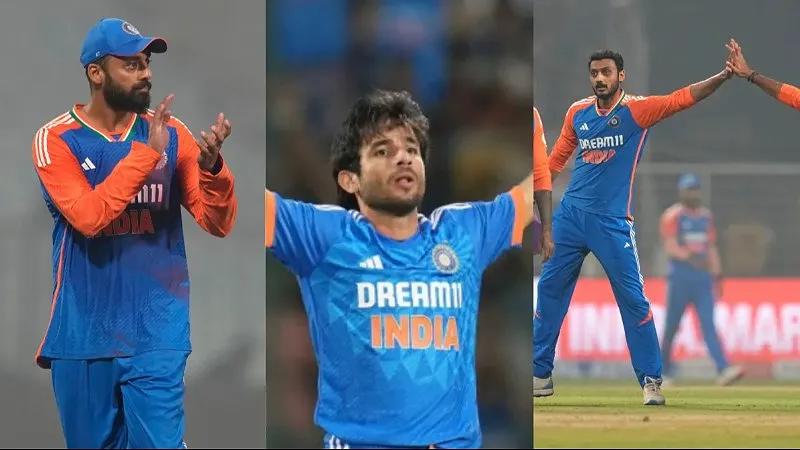

Since winning the T20 World Cup in Ahmedabad in March, India have lost all three completed T20Is they have played, two to Ireland and one to England, all without Jasprit Bumrah managing away from bilateral cricket. Nowhere has the strain shown more than in the death overs, where Ravi Bishnoi and Varun Chakravarthy have been repeatedly taken apart. At Old Trafford on July 4, one over from Bishnoi undid an entire match, and the pattern now threatens to define India’s tour before it even reaches Nottingham.
India’s Winning Formula Cracking Under Pressure
India have lost all three completed T20Is since their World Cup triumph on March 8: two in Belfast against an injury-depleted Ireland, and one to England at Old Trafford, all without Bumrah. The five-match England series already sits 1-0 before the third game in Nottingham on Tuesday. A new captain in Shreyas Iyer, a debutant in Vaibhav Sooryavanshi, and a reorganised bowling attack have all been thrown into the same fire at once, with very little margin for the kind of transition period a side usually gets after a title win.
The 17th Over That Changed Old Trafford
Jacob Bethell carved out an unbeaten 76 from 46 balls at Old Trafford, chasing 191 with an over to spare. England were in trouble at 133 for 5, needing 58 from 28 balls, when Bishnoi’s 17th over changed everything. Bethell struck him for three sixes in that single over, repeatedly exploiting the flat trajectory and the leg side, while two back-foot no-balls turned a 29-from-24 equation into 29-from-18 in one passage of play. The momentum never recovered, and England crossed the line with six balls to spare.
Ireland Series Warning Signs Nobody Heeded
One correction matters here: neither Bishnoi nor Chakravarthy played either Ireland T20I. Chakravarthy was sidelined by a foot injury, while Bishnoi was not selected at all, with Prasidh Krishna bowling in the first match and debutant Prince Yadav in the second. Ireland won both matches comfortably to take that series 2-0. India’s bowling problems in Belfast were real but differently sourced: pace misreads, missed lengths, and no ability to defend modest totals on used surfaces. The wrist-spin concern, by contrast, is specifically and solely an England-leg problem so far, and a damaging one at that.
IND vs ENG T20I 2026 Wrist Spin Economy
Bishnoi finished the Old Trafford match with 0 for 60 in four overs, an economy of 15.00 against a career T20I economy of roughly 7.41. Chakravarthy went for 37 in four overs at an economy of 9.25, removing Will Jacks at a key moment but proving too readable at the other end. Together the pair conceded 97 runs in eight overs for one wicket, a combined economy of 12.13, while England’s own spinners controlled their lines more shrewdly on a surface offering genuine grip and turn.
Bowler | Match | Overs | Runs Conceded | Economy Rate |
Ravi Bishnoi | England 2nd T20I | 4 | 60 | 15.00 |
Ravi Bishnoi | Career T20I average | 172.4 | 1309 | 7.41 |
Varun Chakravarthy | England 2nd T20I | 4 | 37 | 9.25 |
Varun Chakravarthy | Career T20I average | 164.3 | 1250 | 7.56 |
Career figures are approximate T20I averages up to July 2026. Both bowlers were absent for the Ireland series, Chakravarthy through injury and Bishnoi through non-selection.
Fixing This Before The Series Slips
The scalability question cuts deep. Bishnoi’s economy at Old Trafford sits far above the figure he spent several seasons building. Chakravarthy’s 9.25, defensible in isolation, still reflects a growing trend of batters reading his variations more comfortably than they once did. With Bumrah managed away from bilateral cricket, the pace attack of Arshdeep, Harshit Rana and a rotating third seamer is already operating under compression, and when the wrist-spin option concedes 29 in a single death over, there is no cover left and no bowling change that can recover the position.
Bethell’s blueprint, back-foot attack, leg-side aggression, patience against the flat loop, travels to Nottingham with a 1-0 lead and growing confidence. Iyer’s options are limited: Bishnoi remains the designated leg-spinner with no ready replacement, though Axar Patel, the most controlled spinner at Old Trafford, could absorb more overs in the 16-to-19 bracket. The IND vs ENG T20I 2026 wrist spin economy problem will not fix itself before Tuesday.
Does Axar taking on more death-over responsibility solve India’s problem, or does Bishnoi’s leg-spin remain too big a risk to field again? Share your view below.
FAQs
How many runs did Ravi Bishnoi concede in the 17th over?
He conceded 29 runs in the over, including two back-foot no-balls. Jacob Bethell struck three sixes in that spell, and Bishnoi finished the match with figures of 0 for 60 from four overs.
Why is India’s spin attack struggling against England?
Bishnoi and Chakravarthy conceded 97 runs combined in eight overs at Old Trafford. England’s batters, particularly Bethell, read the flat trajectory and attacked the leg side, while Bumrah’s absence leaves India without a seam release valve.
What is Varun Chakravarthy’s economy rate in T20Is?
His career T20I economy is approximately 7.56. At Old Trafford on July 4, he went at 9.25 from four overs, taking one wicket, having missed the Ireland series with a foot injury.
Has India ever lost a T20I series after winning the World Cup?
This is already one of India’s worst post-tournament starts in recent memory. They lost the Ireland series 2-0 and sit 1-0 down in England, having won the World Cup as recently as March.
Who will replace Bishnoi in the next T20I?
No official replacement has been announced for the third T20I in Nottingham. He is expected to keep his place given the squad has no like-for-like alternative, though Iyer may lean more on Axar Patel.