

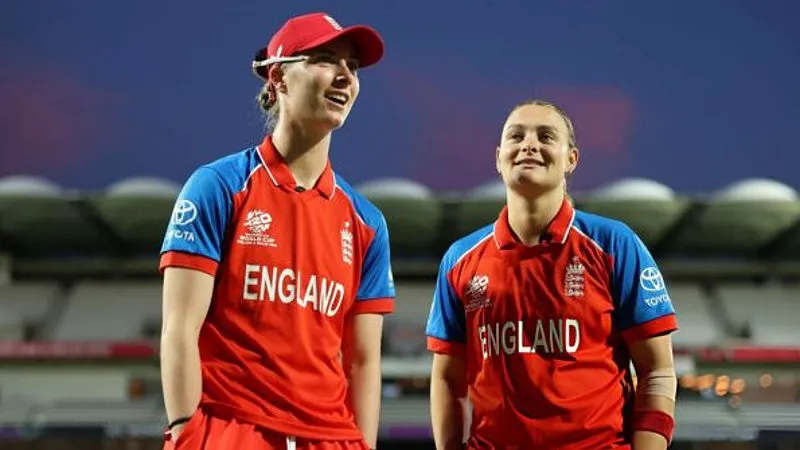

England’s lower-order problem has been one of the defining constraints on this team for years. Freya Kemp and Dani Gibson have spent the past six months dismantling it one innings at a time. The unbeaten 61-run partnership against Scotland at Headingley on June 20 was the clearest public evidence yet of what those two have changed, but the data behind it tells a story that started long before this tournament, across multiple opponents and multiple grounds.
England’s Lower Order Problem in 2025
Across 17 T20I innings in 2025, the players batting at six and seven for England produced at a strike rate hovering around 100, with boundaries coming at a rate below 6%. Runs were being scored, but not fast enough, and not in the phases that win T20 matches. England needed finishers who could change a scoreboard in the final four overs, and those positions were not delivering it. Coach Charlotte Edwards knew it. The data confirmed it repeatedly.
Kemp & Gibson Women’s T20 World Cup 2026
At Headingley against Scotland on June 20, England reached 200/5. The platform she helped build mattered, but the finish that turned a competitive total into a dominant one came from elsewhere. Kemp and Gibson arrived at the crease with three overs remaining and produced 59 runs across that phase, a feat achieved only five times in Women’s T20 World Cup history. Their unbeaten partnership finished at 61, Kemp on 39* and Gibson on 30*.
Dunkley didn’t understate what she’d just watched: “Real six hitters coming in and give us that momentum as well, which is so important going into the second innings.”
Why This Is Systemic, Not a Spike
A single partnership against Scotland could be read as one good day. The numbers across the broader picture don’t allow that reading.
Metric | 2025 (#6/#7 Average) | 2026: Kemp & Gibson |
Strike Rate | 100.00 | 181.92 |
Boundary % | 5.88% | 27.78% |
Partnership vs Scotland | N/A | 61 (39* Kemp, 30* Gibson) |
Pre-WC form (Kemp) | N/A | 39* (13b) vs India; 31* (20b) vs NZ |
The strike rate and boundary rate figures are directional rather than independently audited, but the underlying pattern is consistent: across the New Zealand and India series before this tournament, Kemp and Gibson repeatedly did what England’s lower order couldn’t do in 2025. Multiple innings, multiple opponents, multiple grounds. That is not a spike. That is a structural fix.
Two Careers Built Through Back Injuries
Kemp is a 21-year-old left-arm all-rounder from Sussex who spent large portions of her early career managing back stress fractures. Edwards backed her through those periods. At Bristol on May 30, Kemp came to the crease with England on 129/5 against India and made 39* off 13 balls, leaving them at 168/5. At Derby in the first T20I against New Zealand, she finished unbeaten on 31 off 20, demonstrating the finisher role across different opponents in the weeks before the tournament.
Gibson’s story runs parallel. She had not bowled internationally for more than a year before the World Cup call-up, spending that time rebuilding her action to protect against a back injury recurrence. At Hove, she took 3/14 against New Zealand, career-best T20I figures. Edwards has framed both players as the answer to England’s long-running lower-order problem, and the evidence through this tournament supports that.
What They Free Sciver-Brunt to Do
Nat Sciver-Brunt re-injured her left calf against Ireland on June 16 and will miss the West Indies fixture. A possible return for the final group game against New Zealand at The Oval on June 27 keeps her in the tournament picture. In her World Cup matches, Sciver-Brunt has batted deep in the order as a specialist batter. With Kemp and Gibson providing reliable death-overs firepower, she no longer needs to hold herself back as the late-innings accelerator.
England won their only Women’s T20 World Cup title in 2009, at home, under Charlotte Edwards, who is now the head coach. Kemp & Gibson Women’s T20 World Cup 2026 can’t win this tournament on their own, but by solving the lower-order problem that has constrained England for years, they’ve given the hosts something worth building around.
Is Kemp and Gibson England’s most important partnership at this tournament? Tell us what you think in the comments.
FAQs
How many runs did Kemp and Gibson add against Scotland at Headingley?
Kemp and Gibson put on an unbeaten 61-run partnership, with Kemp scoring 39 and Gibson 30, to help England reach 200/5.** They scored 59 runs in the final three overs, a feat achieved only five times in Women’s T20 World Cup history.
What is Freya Kemp’s best T20I innings before the tournament?
Kemp made 39 off 13 balls against India at Bristol on May 30, arriving with England on 129/5 and leaving them at 168/5.* She also scored 31* off 20 in the first T20I against New Zealand at Derby.
What are Dani Gibson’s best T20I bowling figures?
Gibson took 3/14 against New Zealand at Hove, her career-best T20I figures. She returned those figures after spending more than a year rebuilding her bowling action following a back injury.
Is Nat Sciver-Brunt fit for the rest of this tournament?
Sciver-Brunt re-injured her left calf against Ireland on June 16 and will miss the West Indies fixture. She could return for the final group game against New Zealand at The Oval on June 27.
When did England last win the Women’s T20 World Cup?
England won the title in 2009, at home, under Charlotte Edwards as captain. Edwards is now the head coach, overseeing England’s bid to win on home soil again.