

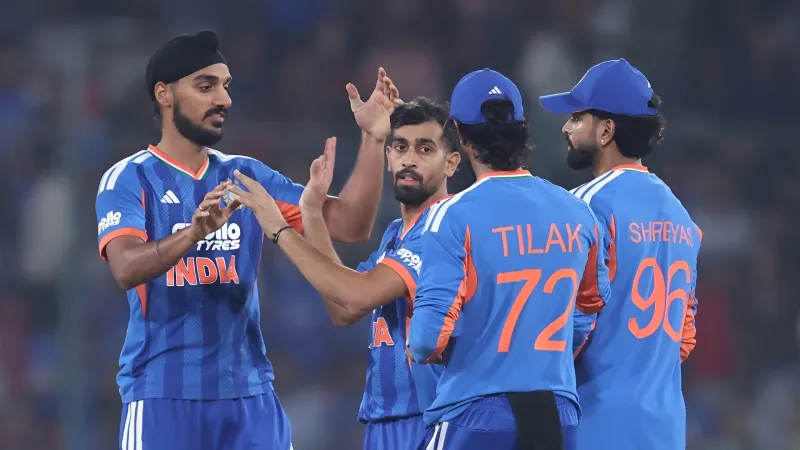

India’s attack is bleeding runs because control has vanished, not because wickets have dried up. West Indies have passed 200 three times in four games, and the series is locked at 2-2 ahead of the Bengaluru decider on 17 October. Every frontline bowler used has an economy above nine, and Naman Dhir tops the list at 11.40. Wickets arrive, but each one costs far too much. The pattern repeated in Ranchi, Indore and Hyderabad, and it has turned a promising home series into a coin toss.
Level at Two Wins Each
The results look balanced, yet the scorecards tell a harsher story. India chased down 171 in Lucknow with eight wickets to spare, then watched West Indies reel in a huge target at Ranchi, finishing on 252/4 inside 18.3 overs. Indore brought a 14-run win in defence, though the visitors still reached 209/7. In Hyderabad, they posted 247/3 and beat a 223 reply by 24 runs.
Three scores above 200 in four games is a worrying pattern for any hosts. Only the Lucknow opener stayed modest, ending in 19.1 overs at 8.92 an over. Every other match ran above ten, and Ranchi peaked at 13.62. The table below lays out the damage game by game.
Match | WI Score | Overs | Economy |
1st, Lucknow | 171 | 19.1 | 8.92 |
2nd, Ranchi | 252/4 | 18.3 | 13.62 |
3rd, Indore | 209/7 | 20 | 10.45 |
4th, Hyderabad | 247/3 | 20 | 12.35 |
India vs West Indies T20I 2026 bowling problems
Four bowlers carry most of the load, and none of them has kept economy under nine. Arshdeep Singh has 5 wickets from 16 overs but conceded 175 runs, an economy of 10.94. Mayank Yadav has 4 wickets for 162 off 15 overs, while Dhir has 5 for 114 in ten overs. Prince Yadav is the cheapest at 9.13, though he has bowled in only two matches.
Wicket columns hide the scale of the leakage. Dhir’s three-wicket debut in Lucknow, 3/31 in four overs, remains his best outing, and Mayank’s 3/36 in Ranchi came inside a match that still cost 252. Arshdeep claimed 3/44 in Indore and took the Player of the Match award, yet that spell still cost eleven an over. Good figures on paper often sit beside runs that simply came too quickly.
Bowler | Matches | Overs | Runs | Wickets | Economy |
Arshdeep Singh | 4 | 16.0 | 175 | 5 | 10.94 |
Prince Yadav | 2 | 8.0 | 73 | 1 | 9.13 |
Naman Dhir | 4 | 10.0 | 114 | 5 | 11.40 |
Mayank Yadav | 4 | 15.0 | 162 | 4 | 10.80 |
Hope and Paul Flip the Fourth Game
Hyderabad produced the most complete beating of the series. Hope stayed unbeaten on 102 from 50 balls, and the visitors finished on 247/3 as nobody could slow him. Keemo Paul then took 5/41 to bowl India out for 223, a 24-run loss.
Chasing 248 demanded an almost flawless batting display, and India finished short of it. Prince Yadav added a single wicket for 36 runs, but one wicket was never going to contain a total above 240. A good chase needs the bowlers to lose control only rarely, and that has not been the case here.
Phase Data Shows Early Pressure
Phase numbers are thin, yet they point to early trouble. West Indies reached 67/1 in the powerplay at Indore and stood at 82/3 after ten overs, so the hosts had briefly pulled things back. In Ranchi, the home batters had blasted 94/1 in their own powerplay, a pace the bowlers then failed to protect.
From 82/3 at the halfway mark in Indore, West Indies still scored 127 in the last ten overs. That shows how late the damage arrives. India won that game only because their total left a cushion of 14 runs.
Bengaluru Decider Leaves Little Room
The decider arrives on 17 October with the series at 2-2, and the pressure now sits squarely on the attack. Dhir and Arshdeep share the lead with five wickets each, while Mayank has four and Prince one. The numbers prove wickets will come, but the real task is slowing the scoring rate.
Fixing this needs better execution of an old plan, not a new one. Cutting economy from eleven to nine an over would have turned two defeats into much closer contests. If the India vs West Indies T20I 2026 bowling problems continue, even a strong batting day may not be enough.
Can India fix this leakage before the decider, or is another 200-plus total inevitable? Tell us in the comments.
Frequently Asked Questions (FAQs)
Why did India lose the fourth T20I against West Indies?
Hope’s unbeaten 102 off 50 balls and Paul’s five wickets decided the match. West Indies posted 247/3, and India’s reply ended on 223, which left them 24 runs short.
What is the series score between India and West Indies?
The series is tied at 2-2 after four matches. Each side has won twice, and the fifth and deciding T20I takes place in Bengaluru on 17 October.
Which bowler took a five-wicket haul in the fourth T20I?
Keemo Paul took five wickets and finished with figures of 5/41. His spell wrecked India’s chase of 248 in Hyderabad and gave West Indies a 24-run win.
What is the highest West Indies total in this series?
West Indies scored 252/4 in the second T20I at Ranchi, their highest total of the series. They reached it in only 18.3 overs, at 13.62 runs per over.
Which Indian bowlers have the most wickets in the series?
Naman Dhir and Arshdeep Singh lead with five wickets each. Dhir has done it at an economy of 11.40 and Arshdeep at 10.94, both well above nine.
Disclaimer: This blog post reflects the author’s personal insights and analysis. Readers are encouraged to consider the perspectives shared and draw their own conclusions.