

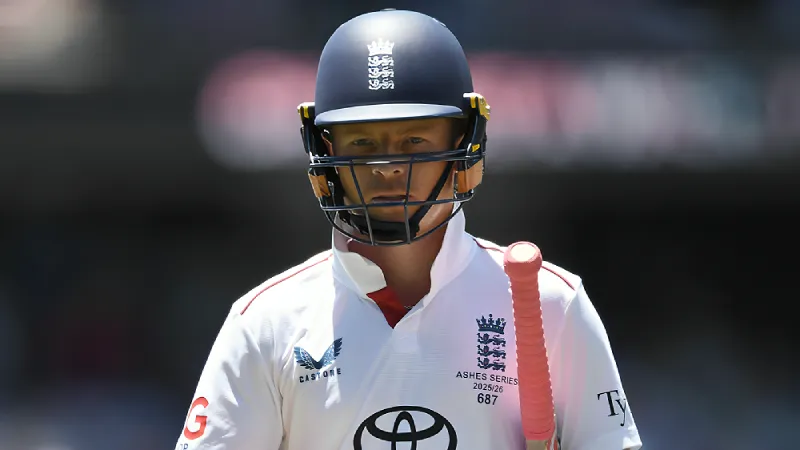

The most revealing moment in Pope’s entire Ashes 2026 story was not a dismissal. It was the press conference after his omission. He sat down, answered the questions, and told the room that England made the right call.
No deflection, no grievance, no suggestion that conditions or selection timing were unfair. Just a direct acknowledgement that six innings without a fifty in Australian conditions meant the decision was justified. That kind
of response from a dropped batter is rarer than a century at the WACA. It also tells you more about Pope’s mindset than any score he produced during the series.
Six Innings No Fifty No Argument
The case against Ollie Pope at No.3 in these conditions built slowly and then all at once. One failure is noise. Two is a concern. Six innings without reaching fifty in an Ashes series against Australia’s pace attack is a pattern
that no selector can overlook, regardless of what the batter has produced before. Test cricket at No.3 demands the ability to absorb the new ball, see off the best spell, and convert starts into innings that change the match.
Pope produced starts. He did not convert them. On surfaces where the penalty for technical error is dismissal rather than a difficult period, the inability to convert becomes the defining measure of whether a batter belongs
in the XI.
Ashes 2026 Gave Bethell the Chance
Jacob Bethell’s immediate response to the opportunity accelerated a transition England’s selectors may have been planning across a longer timeline. A first-class century on debut in the role showed better shot selection
and patience against the same bowling attack that had dismissed Pope repeatedly. That is not luck; it is a different technical approach to the same problem that produces a different result. Bethell’s ability to play later, trust
his defence under pressure, and wait for the right ball to attack gave England the innings-building quality at No.3 that they had been missing throughout the first phase of the series.
England’s Broader Batting Collapse
Pope’s removal did not occur in isolation. England’s batting unit as a collective struggled to build the kind of resistance that the Ashes series in Australia demands. The warm-up schedule before the series left key batters
underprepared for Australian conditions. When the series began, the top order was playing catch-up rather than imposing itself. Travis Head’s counter-attacking innings changed match momentum on multiple occasions
while England’s reply produced collapses that one strong performance could not prevent. Pope was the most visible example of the problem, but the structural issue ran deeper than any single batter’s form.
Where Ollie Pope Goes From Here
Pope has age and experience across 60 Test matches, and a batting record that confirms he is not a player who was ever out of his depth at this level. What he needs is domestic runs against quality bowling before the next
England selection cycle, and he knows it. His own admission that the dropping was correct is the first step; it removes the mental block of feeling victimised and replaces it with a clear task. Fix the back foot play against
pace. Convert the stars he has always created into fifties and hundreds. Return to the Test XI on merit rather than expectation. England’s evolving selection suggests they will prioritise whoever makes that argument most
clearly through runs, not through reputation.
Pope’s exit was not the end of anything. It was a correction. Whether it becomes a turning point or a slide depends entirely on how he responds in county cricket over the next six months. The press conference suggested he
already understands the assignment.
- Can Pope fix his game against pace and force his way back into England’s Test XI, or has Bethell made the No.3 spot his own? Drop your verdict in the comments and follow for cricket updates.
FAQs
Why was Pope dropped during the Ashes?
He was dropped due to poor form, failing to score a fifty in multiple innings, and struggling in Australian conditions.
Can Ollie Pope return to England’s Test XI?
Yes, but he needs consistent domestic performances and technical improvement to regain his place.
How did Jacob Bethell perform after replacing Pope?
Bethell impressed immediately with a century, strengthening his case as a reliable No.3 option.
What went wrong for England in the Ashes overall?
Lack of preparation, inconsistent batting, and inability to handle pressure situations led to their struggles.
Is Pope still part of England’s long-term plans?
He remains in contention, but his place is no longer secure due to rising competition and recent form.