

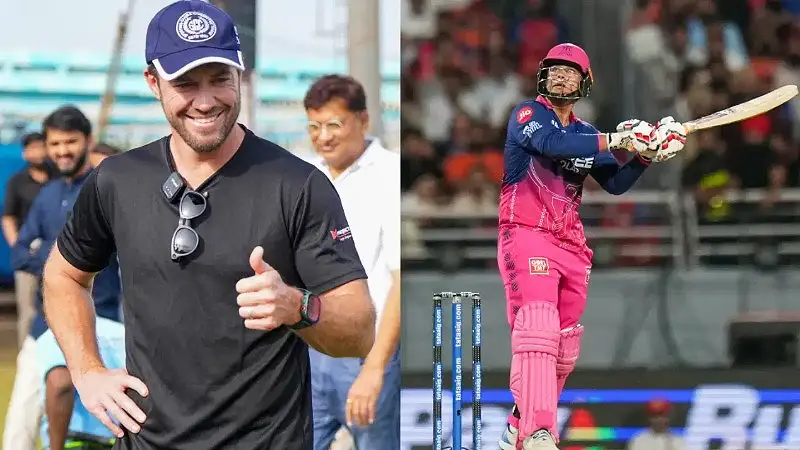

Vaibhav Suryavanshi has posted 440 runs in 11 matches at a strike rate above 236 and struck two rapid centuries for the Rajasthan Royals this season. None of those numbers has quieted the most significant question following him through this campaign. AB de Villiers publicly wondered how Suryavanshi’s ultra-aggressive game survives the sustained examination that Test cricket demands, and that question doesn’t disappear because the powerplay numbers keep rising. The talent is real. The career question is equally real. Both exist simultaneously, and navigating that contradiction is now the central challenge of his development as a cricketer.
Suryavanshi Rewrites the Powerplay Rules
Suryavanshi attacks hard lengths from pace bowlers during the first six overs with a confidence most T20 specialists develop only after several seasons at the highest level. He doesn’t look for width before committing to the shot. Against deliveries above 140 km/h, he attacks earlier in the ball’s trajectory than batters who have spent twice as long in professional cricket, which means bowlers can’t adjust their plans before he has already imposed his game on the powerplay.
Two centuries in fewer than two complete IPL campaigns reflect more than power. Both innings required him to sustain his approach long enough to construct a complete knock rather than generate chaos in a brief cameo. Most young T20 specialists can dominate for five overs. Suryavanshi builds an innings while dominating it simultaneously, and that combination is what separates a high-value powerplay option from a genuine match-winner who changes what a total looks like before the 10th over arrives.
De Villiers Raises IPL 2026 Concerns
AB de Villiers’ comment wasn’t negative for its own sake. It reflected a specific and legitimate tactical concern that any experienced cricketer would raise when watching an approach as aggressively committed as Suryavanshi’s operate at full speed in franchise conditions.
IPL 2026 pitches are designed to produce boundaries. Field restrictions allow aggressive batting to carry lower risk than it would in any other format. That environment rewards exactly the approach Suryavanshi has perfected, because the conditions create structural advantages for it to succeed consistently. Test cricket operates on completely different principles. Bowlers attack identified weaknesses across extended spells lasting hours rather than overs.
Test Cricket Demands a Different Game
The specific challenge Test cricket creates for batters with Suryavanshi’s current style isn’t about talent. It’s about patience, and patience is a learned skill rather than a fixed personality trait. Patience in red-ball cricket means letting a ball outside off stump go without a hard shot, allowing a seamer to find swing without feeding the slips cordon, and waiting overs rather than deliveries for the right scoring opportunity to present itself.
None of that requires Suryavanshi to abandon his natural game permanently. Several players originally defined by T20 aggression have adapted their approaches as red-ball exposure accumulated across full domestic and international seasons. The point is that adaptation takes time, sustained match practice in longer formats, and an environment where failure is treated as a development stage rather than a selection crisis. At 15, he has all of that available. What de Villiers raised wasn’t a verdict on his career. It was an honest question about the timeline required to reach it.
Under-19 Form Answers the Critics
An explosive 175 off 80 balls in an Under-19 World Cup final proved something important that IPL cameos sometimes can’t establish: Suryavanshi can construct a match-defining innings rather than simply damage a bowling attack across a short burst. That scale of knock requires reading the match situation across multiple phases, adjusting to bowling changes, and sustaining intensity for a duration that demands far more than aggression alone provides.
Under-19 international conditions also differ meaningfully from franchise T20 surfaces. Slower pitches and less predictable bowling attacks tested different qualities from his game than a boundary-friendly flat deck does. Performing across those varied environments strengthens the case that his talent base is genuine rather than artificially inflated by conditions built for power hitting. De Villiers asked a fair question.
- Does Vaibhav Suryavanshi’s 440 runs for Rajasthan Royals prove AB de Villiers’ Test cricket concern is premature, or is the question about format adaptability exactly the right one to ask about him right now? Drop your pick in the comments and follow for IPL updates.
FAQs
Q: What did AB de Villiers say about Vaibhav Suryavanshi?
De Villiers publicly questioned how Suryavanshi’s aggressive T20 approach would translate into the demands of Test cricket.
Q: How many runs has Vaibhav Suryavanshi scored this season?
Suryavanshi has scored 440 runs across 11 matches at a strike rate above 236 with two centuries.
Q: Can Vaibhav Suryavanshi play Test cricket for India?
His talent is undeniable, but adapting to red-ball patience and sustained pressure will define his long-format future.
Q: What was Vaibhav Suryavanshi’s best Under-19 performance?
His outstanding 175 off 80 balls in the Under-19 World Cup final proved his talent extends well beyond franchise conditions.
Q: Why is Rajasthan Royals’ backing important for Suryavanshi’s development?
The franchise creates a high-profile platform that accelerates his exposure to quality opposition and high-pressure match situations.