

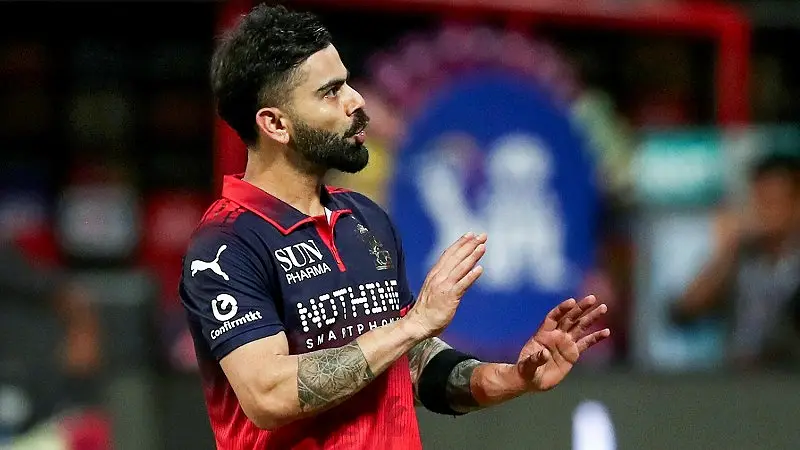

RCB posted 240. RCB won. Virat Kohli scored 50. Those three facts should coexist comfortably. The reason they don’t is the fourth fact: his 50 came off 38 balls at a strike rate of 131 in a match where the surface demanded 180-plus and the batting lineup around him produced it. Rajat Patidar scored 50 off 20 balls in the same innings. Phil Salt was above 200 in the power play. Kohli was measured while everything around him was explosive. RCB won because others compensated. The question the debate is asking is whether compensation should be required from your most experienced batter on the flattest surface in the country.
50 Off 38 Wankhede Needed More
The specific context that makes 131 strike rate genuinely concerning rather than just statistically low is what Wankhede’s conditions were offering on that day. True bounce. Short boundaries. No seam assistance. No swing. A surface where the ball arrived at bat height consistently, and the only bowling threat was exceptional execution rather than surface assistance. In these conditions, the most batting-friendly available in the IPL, 131 strike rate reflects a batter leaving runs on the table that the conditions were specifically making available. The same innings on a slow Chepauk surface with spin assistance would be read differently. On a flat Wankhede deck during a 240-run game, it’s the specific innings that the debate has correctly identified.
Patidar’s 50 Off 20 Changed Everything
The contrast that made Kohli’s innings most visible wasn’t statistical analysis; it was watching the same match in real time and seeing what the conditions were producing from other batters simultaneously. Rajat Patidar scoring 50 from 20 balls in the same innings against the same bowlers on the same surface removed any argument that conditions were making scoring difficult. Both batters faced the same bowling attack, the same pitch, the same field placements. One produced 50 from 20. The other produced 50 from 38. The surface wasn’t the variable. The intent was. That contrast, happening in the same innings rather than across different matches, is what elevated the debate from statistical observation to a genuine tactical question.
IPL 2026 Kohli Anchor or Tactical Limitation
The specific question that Kohli’s innings raised is whether his measured approach reflects a deliberate tactical decision to absorb early risk while others attack or a genuine limitation in his current T20 methodology that no longer suits the format’s evolved scoring demands. The distinction matters because the first interpretation is defensible. An experienced batter who creates space for others to attack freely by taking conservative singles is providing invisible value that the strike rate doesn’t capture. The second interpretation is more damaging: a batter who can’t consistently maintain an above-150 strike rate on flat surfaces is a structural liability in a lineup that needs 240 from only 20 overs. His career record suggests the first interpretation. This innings raises the second.
T20 Cricket Is Outgrowing Pure Anchors
The broader structural shift that Kohli’s innings reflects is the specific evolution in T20 batting philosophy that has made the traditional anchor role, bat through the innings at 120 to 130 strike rate while preserving wickets for the final phase, structurally insufficient at the highest franchise level. The teams consistently posting 200-plus totals are doing so because every position in the batting order maintains an above-140 strike rate rather than relying on one or two explosive batters to compensate for measured contributions elsewhere.
When an even number seven scores at 160-plus, the anchor at number one scoring at 130 becomes a mathematical problem rather than a tactical asset. Modern T20 has evolved toward collective aggression rather than individual role definition.
- Does Virat Kohli adjust his strike rate approach to match the collective aggression that RCB’s 240-plus totals require from every batting position, or does the win-regardless outcome mean the tactical question gets deferred until the match where the compensation isn’t available? Drop your take and follow for IPL updates.
FAQs
What was Virat Kohli’s strike rate in the IPL 2026 MI match?
He scored 50 off 38 balls, resulting in a strike rate slightly above 130, lower than the match average.
Why is Kohli’s innings being criticized despite RCB winning?
Because the match conditions favored aggressive batting, his tempo did not match the overall scoring rate.
How did Rajat Patidar perform against MI?
Rajat Patidar scored a rapid 53 off 20 balls, showcasing high-impact acceleration.
Is anchoring still relevant in modern IPL cricket?
Yes, but anchors now need to maintain higher strike rates due to evolving match demands.