

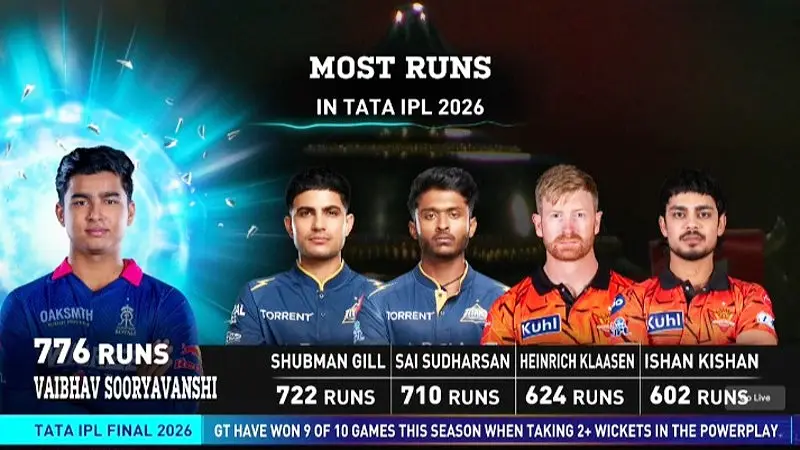

Every IPL season produces records. IPL 2026 produced something different. The individual highlights received attention: Vaibhav Sooryavanshi‘s 72 sixes, KL Rahul’s unbeaten 152, and the Punjab Kings’ pursuit of 265. But the collective picture went largely unexamined at the time. Taken together, the season’s numbers build a case that no major T20 competition has seen before: a batting assault sustained across 74 matches, across multiple venues, against every bowling attack in the competition. The individual records are remarkable. The aggregate is historic.
The Numbers That Define This Season
IPL 2026 produced 27,450 runs across 74 matches at a run rate of 9.88 per over, both all-time IPL records. The season’s 1,426 sixes surpassed IPL 2025’s previous record of 1,294. His 2,332 fours cleared IPL 2023’s mark of 2,174. No rival T20 competition approaches these figures in aggregate: the BBL runs roughly 40 matches per season, the PSL and CPL approximately 34 each. IPL 2026’s raw volume places it in a category no other league can reach.
Record | Previous Best (Tournament / Year) | IPL 2026 Achievement |
Most Sixes in a Season | 1,294 — IPL 2025 | 1,426 sixes |
Most Fours in a Season | 2,174 — IPL 2023 | 2,332 fours |
Most 200+ Team Totals | 52 — IPL 2025 | 65 totals above 200 |
Most Successful 200+ Chases | All-time T20 record entered | 17 successful chases |
Most Centuries in a Season | Prior IPL seasons: fewer than 15 | 15 centuries — all 10 teams represented |
IPL 2026 Batting Records Season T20 History
Before IPL 2026, a 200-plus total was a statement result. Teams crossed 200 on 65 occasions, breaking IPL 2025’s previous record of 52, and 17 of those totals were successfully chased, a new all-time record across all T20 cricket. Punjab Kings’ 265/4 against Delhi Capitals was the highest successful T20 chase ever recorded, anchored by Rahul’s unbeaten 152, the highest score by an Indian in IPL history.
Fifteen centuries were scored during the season, and for the first time in IPL history, all 10 franchises contributed at least one. The record didn’t belong to one team’s batter on one flat pitch. It was distributed across the competition, and that distribution is what separates IPL 2026 from any season before it.
Individual Brilliance Across the Full Season
Sooryavanshi’s 72 sixes across the season came with a strike rate of 237.31, numbers that reflect not merely aggression but precision under sustained pressure. Seventy-two sixes across a full competition means he was clearing the ropes more than once per over bowled at him, on average, across multiple venues and opposition attacks.
Rahul’s unbeaten 152 against Delhi Capitals arrived in a chase of 265, the kind of total that should have been untouchable at any point in T20 history before this season. That it wasn’t simply underlines what IPL 2026 normalised. Kohli contributed at the other end of the aggression spectrum: an average of 56.25 and a strike rate of 165 over the full campaign, across venues including Mumbai, Bengaluru, Ahmedabad, and Hyderabad. The consistency across grounds confirms this wasn’t venue-specific flattery.
Bowlers Outmatched, Pitches Too Flat: Both
Both explanations apply, and the data support neither in isolation. IPL 2026’s season batting average of 31.26 runs per wicket was the highest in IPL history, pointing to surfaces offering minimal assistance for seamers and spinners alike. But surface conditions alone don’t produce a season-wide strike rate approaching 150. Batters have become more precise under pressure, not simply more aggressive.
Sooryavanshi’s 237.31 and Kohli’s 165 were produced on different surfaces across four separate cities. That geographic spread entirely removes the single-venue explanation. What IPL 2026 demonstrated is a convergence: pitches that offered bowlers less, batters who demanded more from every delivery, and 33 century partnerships that confirm the depth of batting quality went well beyond individual brilliance at the top of the order.
What This Season Changes for T20 Cricket
IPL 2026 may represent a genuine inflection point. A season-wide batting strike rate approaching 150, 17 successful 200-plus chases, and 33 century partnerships suggest batters have not simply become more aggressive; they have become more precise under pressure across an entire competition.
If pitch conditions remain as batter-friendly, what was extraordinary in 2026 may become expected by 2028. Franchise cricket faces a structural decision: recalibrate surface preparation to give bowlers a functional role, or accept that the batting spectacle has permanently outgrown the bowling contest. The IPL 2026 batting records season T20 history case rests on dominance across every measurable dimension simultaneously. No competition has ever done that before. Whether it becomes the opening chapter of a new normal depends entirely on what franchises do with their pitches next.
If IPL pitches stay this flat in 2027, does the competition still call itself cricket, or does it need a new name for what batting has become? Drop your take in the comments.
FAQs
How many sixes were hit in IPL 2026?
A record 1,426 sixes were hit in IPL 2026, breaking IPL 2025’s previous mark of 1,294. The season also set all-time IPL records for fours, run rate, and total runs.
What is the highest team total in IPL 2026?
Punjab Kings scored 265/4 against Delhi Capitals, the highest successful T20 chase ever. KL Rahul’s unbeaten 152 was the highest score by an Indian in IPL history.
How many 200-plus totals were scored in IPL 2026?
IPL 2026 produced 65 totals above 200, breaking IPL 2025’s record of 52. Seventeen of them were successfully chased, setting a new all-time record across all T20 cricket.
What was IPL 2026’s total runs record?
IPL 2026 produced 27,450 runs across 74 matches at a run rate of 9.88 per over. Both the runs tally and run rate are all-time IPL records.